Expanding Cells for Super-Resolution Imaging with Antibody Oligo Conjugate Signals Locked in Place
Key takeaways
- Expansion microscopy embeds a sample in a swellable hydrogel and expands it about 4 times, turning a standard microscope into a near super-resolution system; combined with clearing it enables deep-tissue imaging.
- Acrydite-modified oligonucleotide adapters covalently imprint DNA-PAINT docking strands into the hydrogel during polymerization, locking signal positions in place before clearing and preserving nanoscale spatial information.
- DNA-PAINT achieves below 10 nm resolution through transient binding of fluorescent imager oligos to complementary docking strands conjugated to the antibody.
- The adapter design anchors spatial information to the hydrogel while keeping docking strands accessible: the acrydite 3' end incorporates into the polyacrylamide and the 5' end presents the docking sequence.
A new paper that bridges two powerful worlds: DNA-PAINT super-resolution expansion microscopy and hydrogel-based tissue clearing.
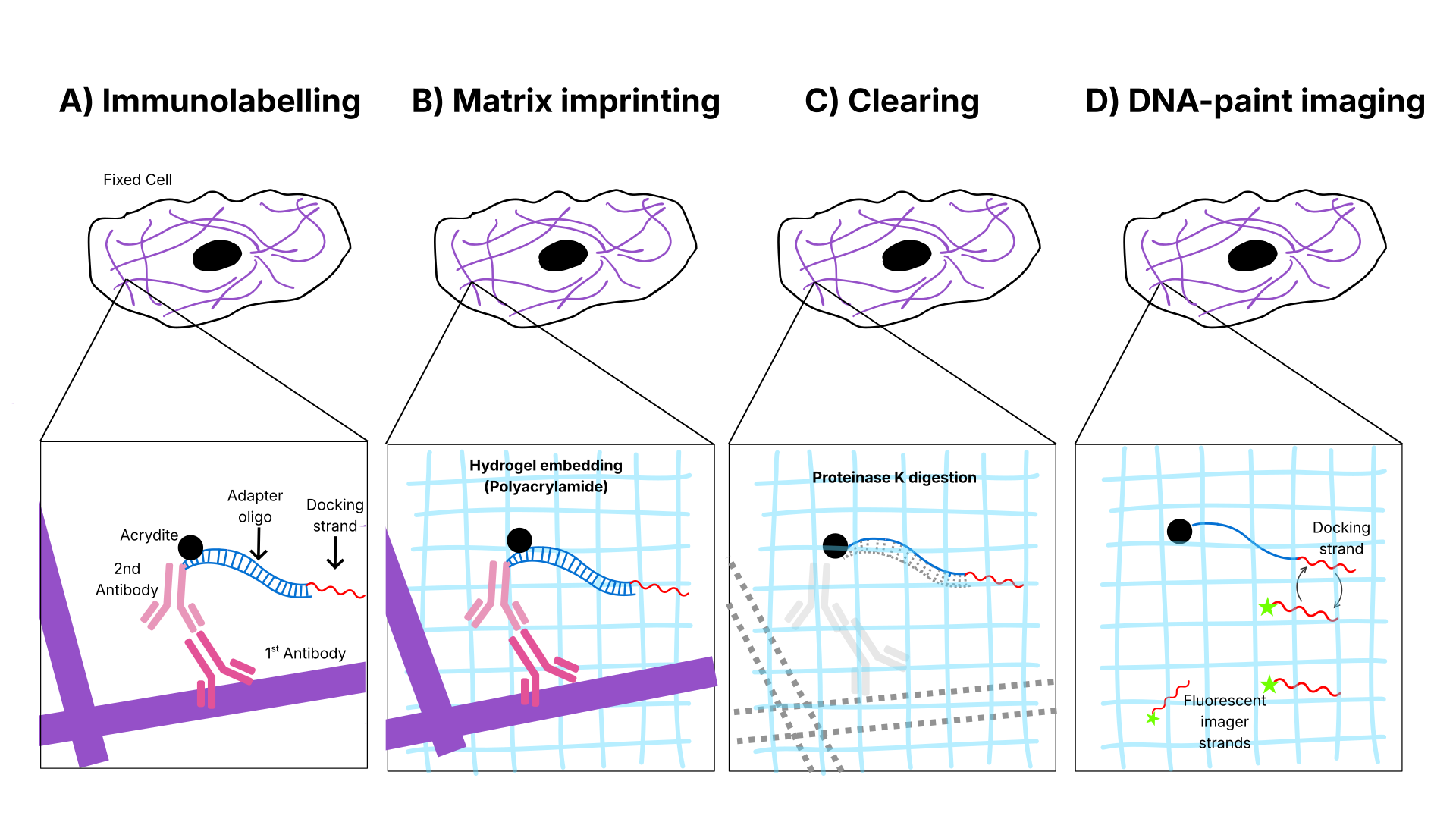
Expansion microscopy: biological samples are embedded in a swellable hydrogel, with biomolecules anchored to the polymer matrix. When the gel expands (typically ~4×), everything moves apart proportionally, turning a standard microscope into something approaching a super-resolution system. Combined with clearing (enzymatic removal of cellular components), this enables imaging deep into tissues. But here's the catch: how do you preserve your carefully placed fluorescent probes through all that?
The Problem
DNA-PAINT achieves remarkable <10 nm resolution through transient binding of fluorescent imager oligos to complementary docking strands (conjugated to the antibody). This dynamic process depends on rapid diffusion. Would imager strands diffuse efficiently through a dense polyacrylamide hydrogel? And could the docking strand positions survive the embedding and clearing process?
The Solution
The team from George Church's legendary lab at the Wyss Institute demonstrated that by using acrydite-modified oligonucleotide adapters, DNA-PAINT docking strands can be covalently “imprinted” into the hydrogel matrix during polymerization. The signal positions are locked in place before clearing, preserving nanoscale spatial information.
How Were the AOCs Designed?
Secondary antibodies carried binding sites for acrydite-labeled docking strand adapter oligonucleotides. The acrydite moiety on the 3′ end covalently incorporates into the polyacrylamide during gelation, while the 5′ end presents the DNA-PAINT docking sequence. This elegant design anchors the spatial information to the hydrogel while keeping docking strands accessible for imaging.
What Will It Take for Broader Adoption?
This proof-of-concept opens possibilities for combining DNA-PAINT with expansion microscopy and tissue clearing. Future applications could enable ultrastructural validation before and after expansion, deep-tissue super-resolution imaging, and integration with spatial workflows. Scaling these approaches will benefit from broader availability of ready-to-use antibody-oligo conjugates, including validated adapters designed to survive hydrogel embedding and clearing workflows.
AbOliGo Products & Services
- Antibody-oligo conjugates (AOCs) — search our rapidly growing catalog
- Custom antibody-oligo conjugation services