Use of site-specific antibody-oligo conjugates in microarray capture applications
Key takeaways
- Site-specific antibody-oligonucleotide conjugates anchor antibodies to DNA-printed microarrays in a uniform orientation, avoiding the denaturation, random orientation and lost binding activity of conventional adsorbed-antibody arrays.
- The conjugate is made by incorporating the unnatural amino acid p-acetylphenylalanine into E. coli-expressed antibodies, then forming a stable oxime linkage to an aminooxy-modified oligonucleotide.
- In Wold et al., trastuzumab Fab conjugates captured HER2-positive (SK-BR-3) cells selectively while HER2-negative cells showed negligible binding, and cutting the DNA anchor abolished capture, confirming specificity comes from DNA hybridization.
- Orthogonal capture sequences let one array support multiplexed detection of multiple protein biomarkers or cell types in parallel.
Conventional microarrays are made by adsorbing antibodies onto hydrophobic or chemically reactive solid surfaces, which can lead to denaturation, random orientation, loss of binding activity and reduced assay sensitivity. To address these challenges, Wold et al. (ref. 1) developed a microarray platform that leverages site-specific antibody–oligonucleotide conjugates.
Antibodies expressed in E. coli are engineered to incorporate an unnatural amino acid, p-acetylphenylalanine (pAcF), using a nonsense amber codon and an orthogonal amber suppressor aminoacyl tRNA synthetase/tRNA pair specific for pAcF. The ketone group of the pAcF residue undergoes a bioorthogonal reaction with single-stranded aminooxy-modified oligonucleotides to form a stable oxime linkage.
Reactions were carried out in the presence of 100 mM methoxy-aniline catalyst at pH 4.5 and 37 degrees for 16 hours, followed by Mono Q anion-exchange chromatography. The production of a homogeneous, site-specifically labeled Fab–oligonucleotide conjugate was confirmed by SDS-PAGE.
The conjugated antibodies can then hybridize to complementary DNA sequences pre-printed on glass slides, anchoring the antibodies in a uniform orientation while preserving their antigen-binding functionality. The selectivity of antibody capture across different arrays was demonstrated using an anti-kappa phycoerythrin conjugate.
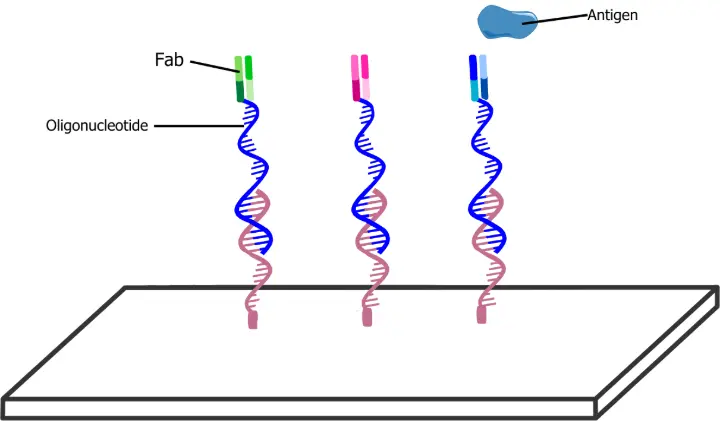
Wold et al. focused on detecting Her2-positive breast cancer cells (SK-BR-3) using Fab fragments of the therapeutic antibody trastuzumab, which was tagged with an oligonucleotide at a surface-exposed light chain site, S202. Modification here is known not to affect antigen-binding affinity or specificity.
The Fab-oligonucleotide conjugates were homogeneous, properly oriented after hybridization, and retained their binding activity. HER2-positive cells selectively bound to the antibody-DNA arrays, whereas HER2-negative cells exhibited negligible binding. By cutting the double-stranded anchor with restriction enzymes, it was shown that capture depended on DNA hybridization, highlighting the platform's specificity.
The application of antibody-oligonucleotide conjugates along with carefully designed orthogonal capture sequences supports multiplexed detection of protein biomarkers or cells.