What Is NULISA?
Ultra-sensitive multiplex proteomics powered by paired antibody-oligonucleotide conjugates
Key takeaways
- NULISA (NUcleic acid Linked Immuno-Sandwich Assay) uses paired antibody-oligonucleotide conjugates and sequential immunocomplex purification to quantify proteins by qPCR or next-generation sequencing.
- The oligo is engineered as part of the assay mechanism, not just a barcode: it enables both purification of intact sandwich complexes and generation of a ligated reporter.
- A dual capture-and-release workflow (oligo-dT capture, release into low-salt buffer, streptavidin recapture) suppresses background more than 10,000-fold versus traditional PLA, reaching attomolar limits of detection with a 7-log dynamic range.
- In multiplex, NULISAseq covers a 200-plex/204-target inflammation panel spanning 9.6 logs of accumulative dynamic range with 91% of assays showing under 1% cross-reactivity.
The commercial case for antibody-oligonucleotide conjugates is no longer hypothetical. In April 2026, Alamar Biosciences raised about $191.3 million in an upsized Nasdaq IPO and reached a roughly $1.53 billion valuation on debut, after revenue rose to more than $74 million in 2025. The scientific engine behind that growth is a proteomic platform built on paired antibody-oligonucleotide conjugates and sequential immunocomplex purification.
Why plasma proteomics is hard
Blood is an attractive liquid-biopsy sample because proteins can provide a more immediate view of physiology and pathology than DNA alone. The challenge is analytical: most blood proteins are present below 1 pg/mL, the plasma proteome spans roughly 12 logs of concentration, and only a small fraction of the estimated 10,000-plus plasma proteins are used routinely in diagnostics. Traditional sandwich immunoassays, even very sensitive ones, struggle to reach the low-abundance end of that range, while multiplexing increases the chance of non-cognate antibody interactions.
Mass spectrometry and immunoassays each solve part of the problem, but not all of it. NULISA was developed in response to three linked bottlenecks: insufficient sensitivity for very low-abundance proteins, rising background in proximity-based assays, and the difficulty of multiplexing high- and low-abundance analytes in the same reaction without letting abundant targets dominate the readout.
What NULISA changes
NULISA stands for NUcleic acid Linked Immuno-Sandwich Assay. Its central innovation is that the DNA attached to each antibody pair is designed to do two jobs at once: first, to enable purification of intact sandwich immunocomplexes; second, to generate a ligated reporter that can be quantified by qPCR or next-generation sequencing. This background-suppression strategy improved sensitivity over traditional homogeneous PLA by about 10,000-fold, reaching attomolar detection.
That is the key AOC insight. The oligo is not merely a barcode attached to an antibody. It is engineered as part of the assay mechanism itself, controlling which complexes survive purification and which ones become readable reporter molecules. From an AbOliGo perspective, this is exactly the type of assay architecture where conjugate design becomes central rather than secondary.
How the paired antibody-oligo conjugates are designed
For each target, the capture antibody is conjugated to a partially double-stranded DNA containing a poly-A tail and a target-specific molecular identifier (TMI). The detection antibody is conjugated to a second partially double-stranded DNA containing a biotin group and the matching TMI. When both antibodies bind the same target, the resulting immunocomplex carries the information needed for two sequential capture steps and then for reporter generation by ligation.
How the dual capture-and-release workflow suppresses background
Once immunocomplexes form, they are first captured on oligo-dT paramagnetic beads through dT-polyA hybridization. This allows sample matrix components and unbound detection antibodies to be washed away. Because dT-polyA binding is salt-sensitive, the intact immunocomplexes can then be released into a low-salt buffer. A second capture step follows: the released complexes are recaptured on streptavidin beads through the biotin on the detection conjugate, allowing additional washing to remove unbound capture antibodies. Only intact sandwich complexes survive both purification steps.
After the second purification, a ligation step generates the reporter DNA. In single-plex NULISA this reporter can be quantified by qPCR; in NULISAseq, sample-barcoded ligators enable pooling of a full 96-well plate into one sequencing run. The workflow is: immunocomplex formation, first capture, wash, release, recapture, ligation, then qPCR or NGS readout.
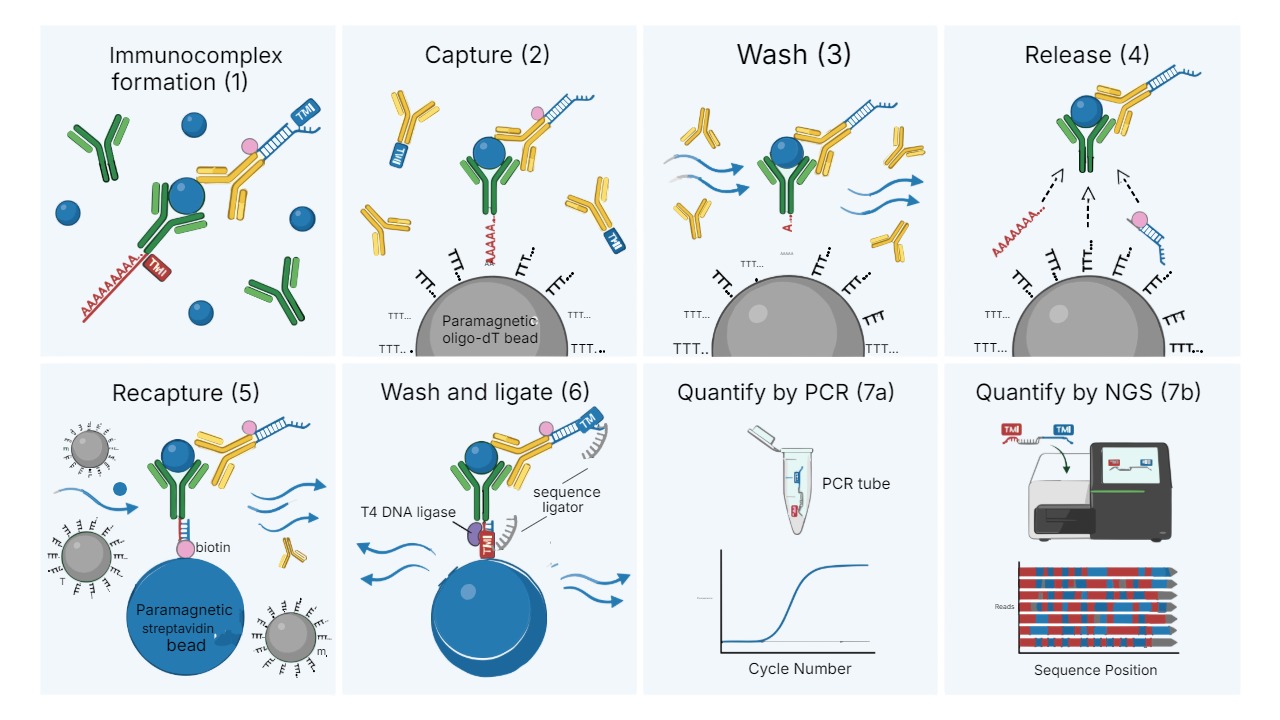
The NULISA workflow: immunocomplex formation, oligo-dT capture, wash, release, streptavidin recapture, ligation, and readout by qPCR or NGS.
What performance NULISA achieved
In the single-plex format, the published work reports attomolar sensitivity with strong dynamic range. For IL4, NULISA reduced background by more than 10,000-fold relative to traditional PLA and reached an attomolar limit of detection with a 7-log dynamic range. Additional single-plex assays for IL6 and CXCL5 achieved limits of detection of 22 aM and 26 aM, respectively. Using the same antibody pair for HIV p24, NULISA achieved a limit of detection of 10 aM (0.24 fg/mL), nearly tenfold lower than SIMOA, while using one-sixth as much sample.
In the multiplex format, the inflammation panel is described as a 200-plex NULISAseq assay covering 204 targets, including 124 cytokines and chemokines. Across all targets, the accumulative dynamic range spanned 9.6 logs, from 17 aM (0.26 fg/mL) to 70 nM (1.63 µg/mL), without sample dilution. Precision was also strong: mean and median intraplate CVs were 10.2% and 9.2%, while mean and median interplate CVs were 10.3% and 9.1%. Cross-reactivity was low, with 91% of assays showing less than 1% cross-reactivity.
Why multiplexing works here
The paper addresses a major NGS-multiplexing problem directly: very abundant proteins can consume sequencing capacity and obscure low-abundance targets. To manage that, the authors mixed unconjugated 'cold' antibodies with DNA-conjugated 'hot' antibodies for high-abundance targets, tuning signal strength while maintaining standard-curve shape. In the 200-plex assay, that strategy allowed low- and high-abundance proteins to be measured together across a broad biological range.
That is a useful lesson for AOC design more broadly. In high-plex proteomics, performance depends not just on having an antibody pair and an oligo tag, but on how the conjugates are balanced, purified, and matched to the intended readout.
Why this matters for AbOliGo
NULISA is a strong example of where the field is moving: away from antibody-oligo conjugates as generic labels and toward antibody-oligo conjugates as engineered assay components. Each target requires two well-characterized AOCs, both carrying precisely designed DNA architectures, both purified properly, and both compatible with sequential capture, ligation and final readout. The platform's performance is therefore inseparable from conjugate design quality.
That is also why the commercial signal matters. Alamar now describes NULISA as an automated proteomics platform with attomolar sensitivity, scalable multiplexing, and broad single-plex dynamic range.
Summary
NULISA solves a central problem in blood proteomics by redesigning paired antibody-oligonucleotide conjugates so they can support both immunocomplex purification and reporter generation. The resulting dual capture-and-release workflow suppresses background before ligation, enabling attomolar sensitivity in single-plex assays and broad, high-specificity multiplexing in NULISAseq. In the published work, that translated into more than 10,000-fold background reduction versus PLA, single-plex 7-log dynamic range, 200-plex/204-target analysis with 9.6-log accumulative dynamic range, and strong detectability for low-abundance cytokines and interferons that are often difficult to measure in blood.
For AbOliGo, the takeaway is straightforward: when the oligo architecture is designed well and the conjugates are characterized properly, antibody-oligonucleotide conjugates do not just support an assay. They define what the assay can do.
Abbreviation table
These are the main abbreviations a reader is likely to encounter on a NULISA page.
| Abbreviation | Meaning |
|---|---|
| AOC | Antibody-oligonucleotide conjugate |
| NULISA | NUcleic acid Linked Immuno-Sandwich Assay |
| NULISAseq | NULISA with next-generation sequencing readout |
| PLA | Proximity ligation assay |
| PEA | Proximity extension assay |
| qPCR | Quantitative polymerase chain reaction |
| NGS | Next-generation sequencing |
| TMI | Target-specific molecular identifier |
| SMI | Sample-specific molecular identifier |
| LOD | Limit of detection |
| LLOQ | Lower limit of quantitation |
| ULOQ | Upper limit of quantitation |
| CV | Coefficient of variation |
| dT beads | Oligo-dT paramagnetic beads |
| SA beads | Streptavidin-coated paramagnetic beads |
Related reading
- Scientific Techniques Using Antibody-Oligonucleotide Conjugates
- Fine Tuning Your Antibody-Oligonucleotide Conjugates
- Approaches for making antibody-oligonucleotide conjugates
- Proximity Ligation Assays for Analyzing Protein-Protein Interactions