Protein–ssDNA Detection by Proximity Ligation Assay
How ssDNA-PLA extends oligo-conjugated proximity ligation from protein–protein interactions to DNA damage repair
Key takeaways
- ssDNA-PLA detects proteins in close proximity to single-stranded DNA in situ at single-cell resolution, pairing an anti-BrdU antibody (which binds BrdU exposed in ssDNA under non-denaturing conditions) with an antibody against a DNA damage response protein.
- The assay was validated for RPA2, RAD51, and BLM, and its signal responded across etoposide, camptothecin, hydroxyurea, and X-ray treatments while dropping after BRCA1 knockdown, consistent with the role of BRCA1 in DNA end resection.
- Specificity is set by the primary antibodies while the oligo-conjugated PLA probes and rolling circle amplification chemistry stay constant, making the same probe architecture adaptable to protein-protein, protein-DNA, and other interaction formats.
- A time course showed BrdU-RPA2 signal rising after 2 hours of etoposide exposure and declining after washout, so the assay can follow resection and repair dynamics rather than only a static endpoint.
ssDNA-PLA adapts the proximity ligation assay to detect protein–single-stranded DNA interactions in situ. Genome-wide BrdU labeling marks newly synthesized DNA, and anti-BrdU staining under non-denaturing conditions recognizes BrdU only when it becomes exposed in ssDNA after DNA end resection. When anti-BrdU is paired with an antibody against a DNA damage response protein, the PLA readout reports that protein in close proximity to resected ssDNA at single-cell resolution.
What ssDNA-PLA Measures
DNA double-strand break repair by homologous recombination depends on DNA end resection, a process that generates 3′ single-stranded DNA overhangs. These resected intermediates are recognized by proteins such as replication protein A, RAD51, and BLM. ssDNA-PLA was developed to measure the proximity of these proteins to ssDNA directly in cells, rather than inferring resection indirectly from protein foci or bulk chromatin assays.
Why Conventional Readouts Leave a Gap
Conventional non-denaturing BrdU immunofluorescence can reveal ssDNA formation, but it does not show which proteins are bound at those sites. Chromatin immunoprecipitation can measure protein occupancy on DNA, yet it does not distinguish binding to ssDNA from binding to dsDNA. Nascent-strand labeling approaches such as iPOND provide useful protein–DNA information, but they require large cell numbers and can have limited resolution for short, low-abundance ssDNA intermediates. ssDNA-PLA was positioned specifically to fill this gap with an in situ, single-cell readout of protein–ssDNA proximity.
How the Assay Works
Cells are cultured with BrdU so that the analog is incorporated into newly synthesized genomic DNA. Following DNA damage or replication stress, end resection exposes BrdU-containing ssDNA regions. Under non-denaturing conditions, BrdU in intact dsDNA remains masked by base pairing and is not detected by anti-BrdU antibodies; once DNA becomes single-stranded, the epitope is exposed. Anti-BrdU is therefore used as a molecular handle for ssDNA, while a second primary antibody targets a protein of interest.
The experimental workflow evaluated in the report used 10 μM BrdU for 20 hours, followed by treatment with etoposide (20 μM, 2 hours), camptothecin (2 μM, 2 hours), X-ray irradiation (10 Gy, 2 hours), or hydroxyurea (10 mM, 4 hours), depending on the condition being tested. After pre-extraction, fixation, and blocking, samples were incubated with anti-BrdU and antibodies against RPA2 phospho-S33, RAD51, or BLM.
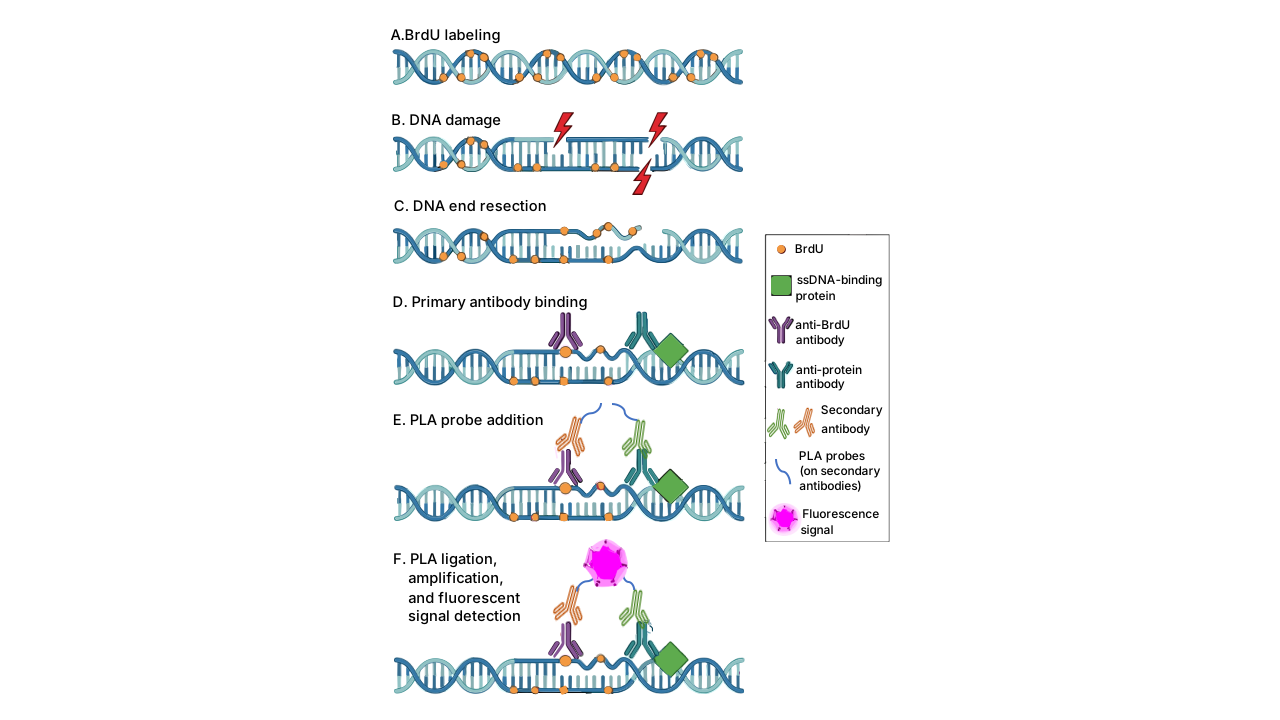
Schematic overview of a BrdU-based proximity ligation assay used to detect interactions between proteins and single-stranded DNA. Cells are first cultured in medium containing 10 µM BrdU (A) and then exposed to conditions that induce DNA double-strand breaks (B). DNA end resection at the damaged sites generates regions of ssDNA (C). After fixation, the cells are incubated with a primary antibody against the ssDNA-binding protein of interest and with an anti-BrdU mouse monoclonal antibody, which binds BrdU exposed in ssDNA under non-denaturing conditions (D). The cells are then treated with oligonucleotide-conjugated secondary antibodies (E). When the ssDNA-binding protein is positioned close to BrdU-labeled ssDNA, connector oligonucleotides bring the PLA probes together and enable ligation, forming a circular DNA template that is amplified by rolling circle amplification. Fluorescently labeled detection oligonucleotides hybridize to the amplified product, generating discrete fluorescent spots that indicate protein–ssDNA proximity events (F).
How the PLA Probes Are Configured
The oligo-conjugated components were commercial secondary PLA probes rather than custom primary antibody conjugates. Anti-mouse MINUS and anti-rabbit PLUS probes were used to detect the mouse anti-BrdU antibody and the rabbit antibody directed against the DNA damage response protein. When the two primary antibodies bind within roughly 40 nm, connector oligonucleotides support ligation into a circular DNA template, followed by rolling circle amplification and fluorescent detection of discrete puncta.
This probe design is important from an AOC perspective because it highlights the modularity of proximity ligation chemistry. The oligo-conjugated probes remain constant, while assay specificity is defined by the choice of primary antibodies. That makes the same probe architecture adaptable to protein–protein detection, protein–DNA proximity measurements, and potentially other interaction formats.
What Was Demonstrated
The assay robustly detected RPA2–ssDNA proximity after etoposide treatment in both U2OS and HeLa cells, with minimal signal in single-antibody controls. The same BrdU-based PLA strategy was then extended beyond RPA2 to BLM and RAD51, showing increased BrdU-BLM and BrdU-RAD51 PLA signals following etoposide treatment in U2OS cells.
The method was also challenged with multiple DNA-damaging conditions. BrdU-RPA2 PLA signals increased after camptothecin treatment, hydroxyurea treatment, and X-ray irradiation, supporting the utility of the assay across replication stress and double-strand break contexts. An alternative anti-BrdU antibody produced a comparable response, indicating that the readout was not restricted to a single BrdU clone.
A time-course experiment further showed that BrdU-RPA2 PLA signal rose strongly after 2 hours of etoposide exposure and then declined after drug washout, with a clear reduction by 4 hours and further loss by 8 hours. This established that the assay can follow the dynamics of DNA end resection and repair rather than providing only a static endpoint.
The assay was also sensitive to genetic perturbation. BRCA1 knockdown significantly reduced the etoposide-induced BrdU-RPA2 PLA signal, consistent with the known role of BRCA1 in DNA end resection. This supports the use of ssDNA-PLA as a functional readout for factors that regulate resection and homologous recombination.
What ssDNA-PLA Adds to AOC Thinking
In proximity ligation workflows, the oligo-conjugated probes provide the ligation and amplification chemistry, but assay specificity is driven primarily by the primary antibodies. That separation of function is what makes the format flexible. In ssDNA-PLA, one specificity is redirected from a protein epitope to exposed BrdU in ssDNA, while the oligo-conjugated PLA probes and rolling circle amplification chemistry remain unchanged.
Summary
ssDNA-PLA combines BrdU labeling of genomic DNA with oligo-conjugated PLA secondaries to detect proteins in close proximity to ssDNA under non-denaturing conditions. The method was validated for RPA2, RAD51, and BLM; shown to respond across multiple DNA damage and replication-stress conditions; and used to monitor resection kinetics and BRCA1-dependent regulation. Scientifically, it is a clean example of how the 'proximity' in proximity ligation assay can extend beyond protein–protein interactions to protein–DNA relationships in situ.
Abbreviation Table
The abbreviations below are the main terms used in this workflow.
| Abbreviation | Meaning |
|---|---|
| AOC | Antibody-oligonucleotide conjugate |
| PLA | Proximity ligation assay |
| ssDNA-PLA | Single-stranded DNA proximity ligation assay |
| ssDNA | Single-stranded DNA |
| dsDNA | Double-stranded DNA |
| DSB | DNA double-strand break |
| DDR | DNA damage response |
| HR | Homologous recombination |
| BrdU | 5-bromo-2′-deoxyuridine |
| RPA / RPA2 | Replication protein A / replication protein A2 subunit |
| RAD51 | DNA recombinase RAD51 |
| BLM | Bloom syndrome helicase |
| BRCA1 | Breast cancer type 1 susceptibility protein |
| RCA | Rolling circle amplification |
| ETO | Etoposide |
| CPT | Camptothecin |
| HU | Hydroxyurea |
Relevant AbOliGo Knowledge Hub articles
- Scientific Techniques Using Antibody-Oligonucleotide Conjugates
- Proximity Ligation Assays for Analyzing Protein-Protein Interactions
- Who is using proximity ligation assays, and what for?
- Approaches for making antibody-oligonucleotide conjugates
Reference
Yang Y et al. ssDNA-PLA, a proximity ligation assay to interrogate DNA repair proteins in close proximity to single-stranded DNA. Biology Methods and Protocols (2026). Open article