Key takeaways
- Activity-dependent proximity ligation (ADPL) combines activity-based chemical probes with antibody-oligonucleotide proximity ligation to detect active enzymes in intact cells, not just where a protein is or how much is present.
- Because signal is generated only when a probe-labeled active enzyme and the antibody detection system converge on the same molecule, the readout is activity-dependent rather than abundance-based, and rolling circle amplification gives single-cell and subcellular resolution.
- In the original 2017 study, ADPL quantified active NCEH1, a cancer-associated serine hydrolase, distinguishing aggressive from non-aggressive cancer cell lines and working in patient-derived ovarian cancer spheroids of only hundreds of cells.
- AOC design still matters: the oligonucleotide controls whether ligation and amplification occur, so antibody specificity and oligo accessibility must be preserved after conjugation.
Most protein analysis methods tell you where a protein is found or how much of it is present. That is useful, but it does not always answer the more important question: is that protein actually active? In 2017, Gang Li and colleagues described an approach called activity-dependent proximity ligation, or ADPL, that was designed to measure active enzymes in intact cells while preserving spatial context. Their study showed how chemical activity probes could be combined with proximity ligation and oligonucleotide-based signal amplification to detect active enzymes with single-cell and subcellular resolution.
ADPL Provides Deep Insights into Enzymatic Function and Spatial Location
Traditional proteomic methods often rely on lysed or homogenized samples. That works well for measuring protein abundance or broad activity profiles, but it removes the spatial information that helps explain what is happening inside cells and tissues. The value of ADPL is that it keeps that spatial context intact. Rather than asking only whether an enzyme is present, it asks whether that enzyme is active in a specific cellular location.
Key insight: Rather than asking only whether an enzyme is present, ADPL asks whether that enzyme is active in a specific cellular location — preserving spatial context that is usually lost in bulk proteomic workflows.
This idea also fits naturally with AbOliGo's Knowledge Hub article on Scientific Techniques Using Antibody Oligonucleotide Conjugates, which places proximity ligation assay among the core AOC-enabled methods for spatially resolved protein analysis.
What ADPL Does Differently
The ADPL approach combines activity-based chemical probes with proximity-dependent oligonucleotide amplification. In practical terms, active enzymes are first tagged with a cell-permeable probe inside live cells. Detection then depends on a proximity ligation step, so signal is generated only when the probe-labeled enzyme and the antibody-based detection system converge on the same target. This makes the readout activity-dependent rather than abundance-based.
That is where the method becomes especially interesting. A conventional immunofluorescence experiment might show where NCEH1 is located, but not whether it is catalytically engaged. ADPL was developed to bridge that gap.
How the Assay Works
The study used an antibody-oligonucleotide-based proximity ligation format to convert molecular recognition into an amplifiable DNA signal. As outlined in the paper summary, enzyme activity was captured first with the probe, after which antibody recognition of both the probe handle and the protein of interest enabled the proximity ligation step. Signal appeared only when both recognition events occurred on the same molecule in close proximity.
The article Proximity Ligation Assays for Analyzing Protein Interactions explains the core PLA workflow in a way that directly supports understanding of ADPL. It describes how antibody-bound oligos are brought into proximity, ligated into a circular DNA template, and then amplified by rolling circle amplification to create bright localized fluorescent signal. It is this core detection principle that makes ADPL work.
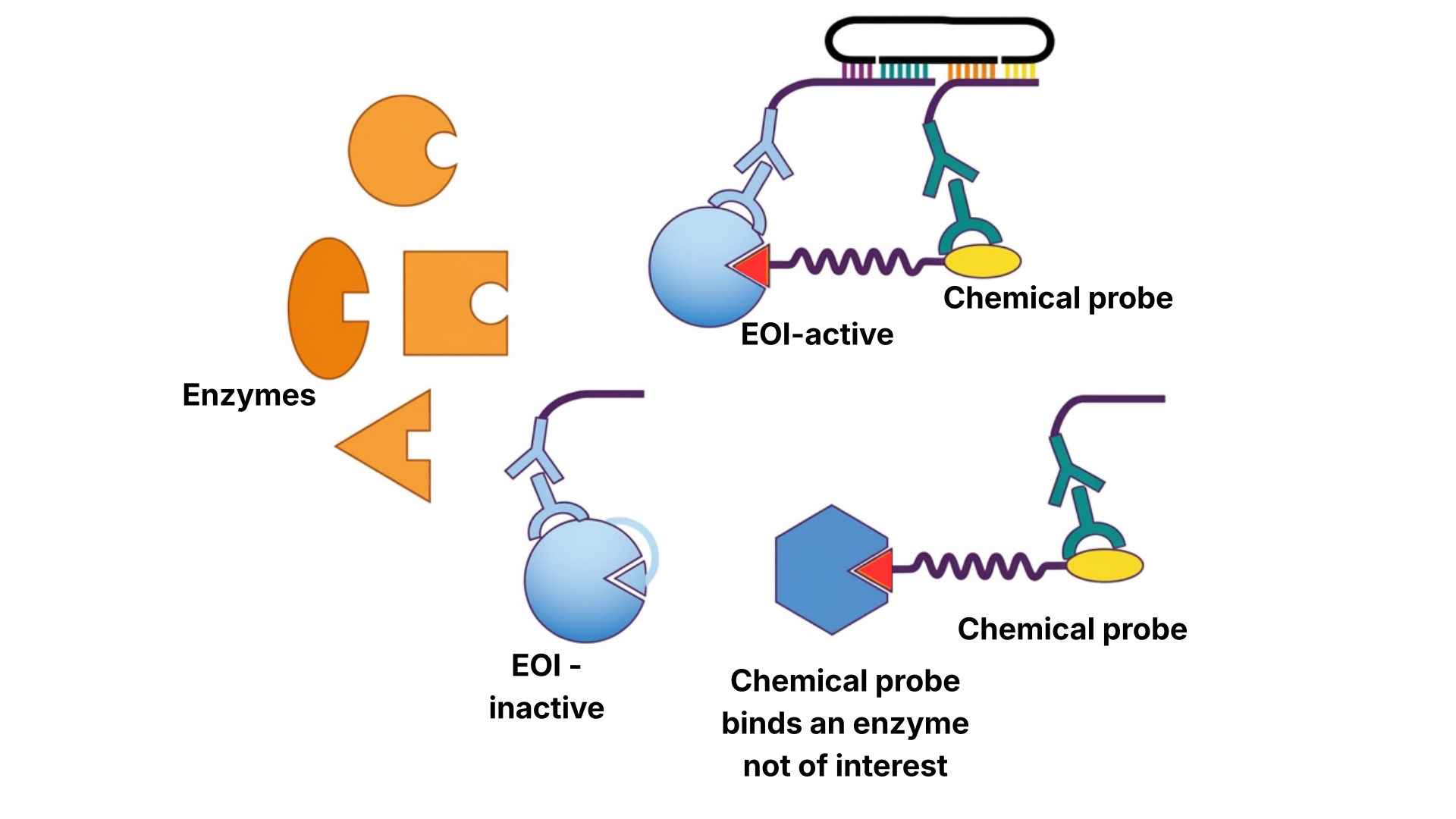
Schematic diagram of the ADPL assay — the enzyme of interest (EOI) is bound by the primary antibody and the chemical probe. Attachment of secondary antibodies conjugated to oligonucleotides are brought into proximity, thus displaying a readout signal demonstrating the EOI is present and active. If the enzyme of interest is not active (EOI-inactive) or the chemical probe binds an enzyme not of interest, there is no readout signal.
Scientific Results
The study centered on NCEH1, described as a cancer-associated serine hydrolase, and used ADPL to quantify active enzyme levels at single-cell resolution. The platform enabled spatially resolved quantification of active enzymes in single cells and should be adaptable to diverse probe and protein families.
Key result: The method distinguished active NCEH1 levels between aggressive and non-aggressive cancer cell lines, showed subcellular resolution by tracking relocalized active enzyme signal, and was applied to patient-derived ovarian cancer spheroids containing only hundreds of cells.
Why AOC Design Still Matters
Although the paper is focused on enzyme activity, it also illustrates a broader point about reagent design. In PLA-style assays, the oligonucleotide component is not passive. It controls whether ligation and downstream amplification can occur, so conjugate design has a direct effect on assay performance. Antibody specificity, oligo accessibility, and background control all matter. That is why AbOliGo's Fine Tuning Your Antibody Oligonucleotide Conjugates specifically discusses engineered AOCs in PLA and notes that antibody binding and specificity must be maintained after conjugation.
Summary
The strength of ADPL is that it asks a better biological question. Not just where is the protein, but where is it active. By combining activity-based probes with oligonucleotide-driven proximity ligation and rolling circle amplification, the method preserves information that is usually lost in bulk proteomic workflows. The authors also noted that the platform should be amenable to diverse probe and protein families, which suggests broader potential beyond the original NCEH1 study.
For that reason, this paper still stands out as a strong example of what AOC-enabled methods can add to functional proteomics. It shows that spatial context and biochemical activity do not need to be measured separately.
Relevant AbOliGo Enzyme Products
| SKU | Product Name |
|---|---|
| aoc27 | Anti-LRRK2 Antibody-Oligo Conjugate |
| aoc29 | Anti-ALDH1L1 Antibody-Oligo Conjugate |