Single-Exosome Profiling by Proximity Barcoding Assay
How antibody-oligonucleotide conjugates convert extracellular vesicle surface protein phenotypes into sequencing-readable barcodes
Key takeaways
- Proximity barcoding assay (PBA) profiles surface proteins on individual exosomes by converting them into sequencing-readable DNA barcodes, resolving multi-protein phenotypes at single-vesicle level rather than averaging across pooled vesicle populations.
- Exosomes are captured via immobilized cholera toxin subunit B, which binds GM1 gangliosides in the vesicle membrane, and oligonucleotides on antibodies bound to the same exosome acquire a common barcode from a rolling circle amplification product.
- The platform profiled 38 human proteins on exosomes from 18 different human sources, including serum, seminal fluid, and conditioned media, distinguishing vesicle subpopulations by surface protein combinations and abundance.
- In PBA the oligonucleotide is not a passive label: it is the programmable information layer that links target identity, vesicle association, and sequencing-based readout, which is why conjugate design matters as much as antibody specificity.
Single-exosome profiling extends the logic of antibody-oligonucleotide conjugates into extracellular vesicle analysis by converting exosome-associated surface protein phenotypes into sequenceable DNA information. In proximity barcoding assay (PBA), antibody-DNA probes are used to investigate individual exosomes rather than pooled vesicle populations, allowing surface protein signatures to be resolved at single-vesicle level. This is particularly relevant for liquid biopsy, because extracellular vesicles are heterogeneous and bulk measurements can obscure low-abundance but biologically relevant subpopulations.
Why Single-Exosome Profiling Matters
Exosomes are a subclass of membrane-coated extracellular vesicles of roughly 30–100 nm that are released by exocytosis and detected in multiple body fluids. Their surface proteins carry information about tissue of origin, making them attractive as disease-associated biomarkers. The limitation of bulk exosome analysis is that it can report whether a marker is present in the sample overall, but it does not robustly resolve which markers are present on the same individual vesicle. For heterogeneous vesicle populations, this is the major analytical constraint. PBA addresses this by preserving vesicle-level surface protein signatures rather than averaging them away.
PBA Workflow
The workflow uses antibody-DNA conjugates together with rolling circle amplification (RCA)-derived DNA barcodes. Exosomes are first incubated with PBA probes (figure 1) in solution and are then captured in microtiter wells via immobilized cholera toxin subunit B (figure 2), which binds GM1 gangliosides in exosome membranes. RCA products carrying repeated barcode sequences are then introduced (figure 3). Oligonucleotides on antibodies that have bound the same exosome can hybridize to the same RCA product, after which enzymatic extension transfers the barcode sequence (figure 4). The resulting DNA is amplified by PCR, prepared as a sequencing library, and decoded by next-generation sequencing (figure 5).
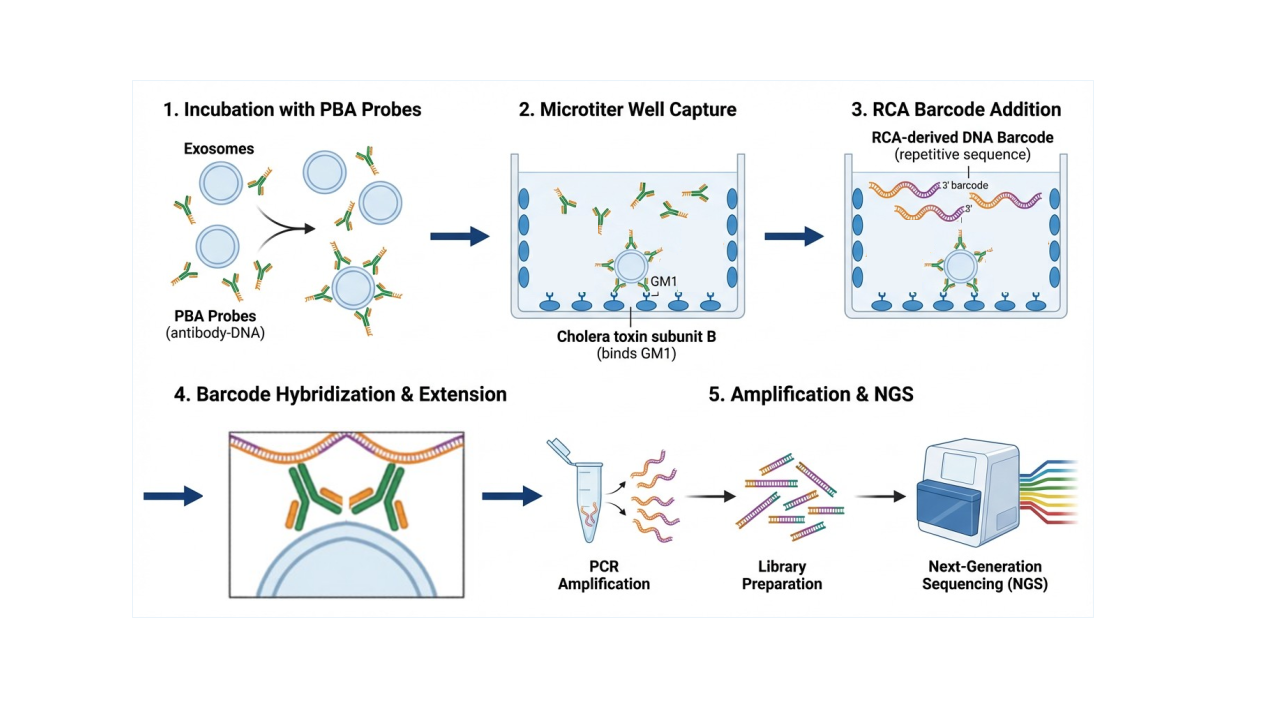
Proximity barcoding assay (PBA) workflow for single-exosome surface protein profiling. Antibody-DNA probes bind exosome surface proteins (1), exosomes are captured via cholera toxin subunit B (2), RCA products carrying complexTag barcodes are introduced (3), enzymatic extension transfers barcodes to bound antibody oligos (4), and sequencing decodes multi-protein surface phenotypes at single-vesicle resolution (5).
Antibody-DNA Probe Architecture
Each PBA probe is generated by conjugating an antibody to a DNA oligonucleotide that contains an 8-nt proteinTag identifying the target surface protein and an 8-nt random moleculeTag used as a unique molecular identifier after amplification. A second DNA layer is introduced through RCA products generated from circular oligonucleotides containing a 15-nt complexTag. Each RCA product contains many repeated copies of a single complexTag, allowing proteins bound to the same exosome to acquire a common barcode.
Key point: The oligonucleotide is not functioning as a passive label. It is the information-layer that links target identity, vesicle association, and sequencing-based readout.
What PBA Resolves
The platform was used to profile 38 human proteins on exosomes from 18 different human sources, including serum, seminal fluid, and conditioned media from multiple human cell lines. Exosomes from different sources could be distinguished by specific combinations of surface proteins and by differences in abundance. In practical terms, this means PBA can classify extracellular vesicle subpopulations on the basis of multi-parameter surface phenotypes rather than single-marker readouts alone.
Why the Conjugate Design Matters
From an AOC perspective, assay performance depends on more than antibody specificity. The oligonucleotide must be compatible with barcode transfer, PCR amplification, and sequencing-based decoding while preserving target binding. That is why PBA aligns so closely with AbOliGo's broader content on proximity ligation assays, approaches for making antibody-oligonucleotide conjugates, and the wider survey of scientific techniques using antibody-oligonucleotide conjugates. In all of these formats, the oligo defines how protein recognition is encoded, amplified, and interpreted downstream.
Translational Relevance
For extracellular vesicle research, the main value of PBA is that it enables high-multiplex single-exosome surface profiling by sequencing. That creates a route to identify vesicle subpopulations associated with tissue origin, disease state, or therapeutic response. The same underlying assay logic has also moved into commercial positioning, where single-exosome proximity barcoding is now presented as a high-throughput platform for analyzing large numbers of vesicles across multiple sample types. For scientists working in biomarker discovery, oncology, neurology, or liquid biopsy, that progression from assay concept to platform is notable.
Conclusion
PBA is a strong example of where the field is heading. Antibody-oligonucleotide conjugates are no longer being used only as specialist labeling reagents. Increasingly, they are the programmable molecular components that determine how proteins are barcoded, spatially associated, amplified, and read out. In assays such as PBA, the antibody provides the protein-binding layer, while the oligonucleotide defines the analytical readout.
Key insight: In PBA, the oligonucleotide is not a passive label — it is the programmable information layer that links target identity, vesicle association, and sequencing-based readout at single-exosome resolution.
Relevant AbOliGo Products
| SKU | Product Name | Vesicle Relevance |
|---|---|---|
| aoc9 | Anti-VGLUT1 Antibody-Oligo Conjugate | Synaptic vesicle membrane transporter that could support exploratory phenotyping of excitatory neuron-associated vesicle populations. |
| aoc10 | Anti-GABA-B-R1 Antibody-Oligo Conjugate | Membrane receptor target that may be useful in multiplex panels aimed at inhibitory neuronal signatures. |
| aoc26 | Anti-NMDAR1 Antibody-Oligo Conjugate | Ionotropic glutamate receptor subunit suited to neuro-focused surface phenotyping strategies. |
| aoc28 | Anti-Ionotropic Glutamate Receptor 2 Antibody-Oligo Conjugate | AMPA receptor subunit relevant to multiplex readouts of glutamatergic membrane phenotypes. |