Can 41 Targets Be Resolved in Just 6 Rounds of DNA-PAINT?
A deeper look at combinatorial barcoding for faster high-plex super-resolution imaging
Key takeaways
- Combinatorial DNA-PAINT (Combi-PAINT) encodes each target as a combination of orthogonal oligo sequences instead of one docking strand per target, so multiplexing scales nonlinearly with imaging rounds rather than linearly.
- The method resolved 41 targets in just 6 imaging rounds across a 100 × 100 μm² field of view, with localization precision around 2.5 nm, decoding accuracy around 90%, and total acquisition time under 30 minutes.
- The key redesign sits in the oligo layer: each target carries a handle strand that recruits multiple orthogonal imager strands, while the antibody still provides target specificity.
- Broader adoption depends on AOCs with well-characterized, orthogonal, kinetically balanced handle sequences, raising the bar for reagent design and QC.
Combi-PAINT is a combinatorial DNA barcoding strategy for multiplexed high-resolution microscopy built on the logic of DNA-PAINT. Instead of assigning one unique docking strand and one imaging round to each target, the method encodes targets as combinations of orthogonal oligo sequences and decodes identity computationally after imaging.
This matters because the practical bottleneck in highly multiplexed DNA-PAINT is not usually conceptual. It is operational. Traditional workflows scale almost linearly with target number, so every additional protein typically means another exchange step, another acquisition round, and more total microscope time. Combi-PAINT changes that scaling relationship — 41 targets were resolved in 6 imaging rounds across a 100 × 100 μm² field of view, with total acquisition time under 30 minutes.
Key result: 41 targets resolved in just 6 imaging rounds across a 100 × 100 μm² field of view, with localization precision around 2.5 nm, decoding accuracy around 90%, and total acquisition time under 30 minutes.
Why Conventional DNA-PAINT Slows Down at High Plex
DNA-PAINT has become one of the most elegant uses of antibody-oligonucleotide conjugates in advanced imaging. Antibodies carry DNA docking strands, and fluorescent imager oligos transiently bind those docking sites to generate localization events. The format offers strong multiplexing potential because sequences can be reassigned. But in its conventional form, each target often still needs its own docking strand and its own imaging round.
At low plex, that is manageable. At high plex, it becomes limiting. Longer imaging sessions reduce throughput, increase the burden on fluidics, make panel expansion less practical, and increase opportunities for drift or registration error between rounds. Related improvements to DNA-PAINT, such as Solving Nuclear Imaging with Left-Handed DNA, show how much innovation is now focused on removing these operational constraints rather than simply proving that multiplexing is possible.
How Combinatorial Barcoding Changes the Math
Combi-PAINT replaces the one-target/one-sequence model with a combinatorial code. Instead of giving each target a single unique docking identity, each target is assigned a defined combination of orthogonal sequence elements. A target may be positive for imagers A and C but negative for imagers B, D, and E, creating a binary signature that can be decoded after imaging. Because target identity is carried by combinations rather than single labels, multiplexing can scale nonlinearly with the number of imaging rounds.
That is the conceptual leap. With six base imaging rounds and selected combinations of those rounds, the system can create far more identities than six. This shifts DNA-PAINT from a linear barcoding model to a compact coding scheme that starts to look much more like information design than simple one-to-one labeling.
How the Antibody-Oligo Conjugates Were Designed
From an AbOliGo perspective, the most interesting part of the paper is the handle-strand architecture. Each target carries an oligo handle strand that can recruit multiple orthogonal imager strands. By varying which docking elements are present in that handle, the same basic antibody-oligo concept can be used to generate different combinatorial identities.
This is important because it means the key redesign sits in the oligo layer. The antibody still provides target specificity, but the oligo now determines code space, compatibility, and decoding logic. In principle, existing DNA-PAINT conjugates can be adapted by redesigning the handle sequence rather than rebuilding the entire assay format. That broader idea aligns closely with AbOliGo's discussion in Should We Barcode All Research Antibodies with Oligos?: the more standardized and well-characterized the oligo layer becomes, the more flexibly antibodies can move between multiplex platforms.
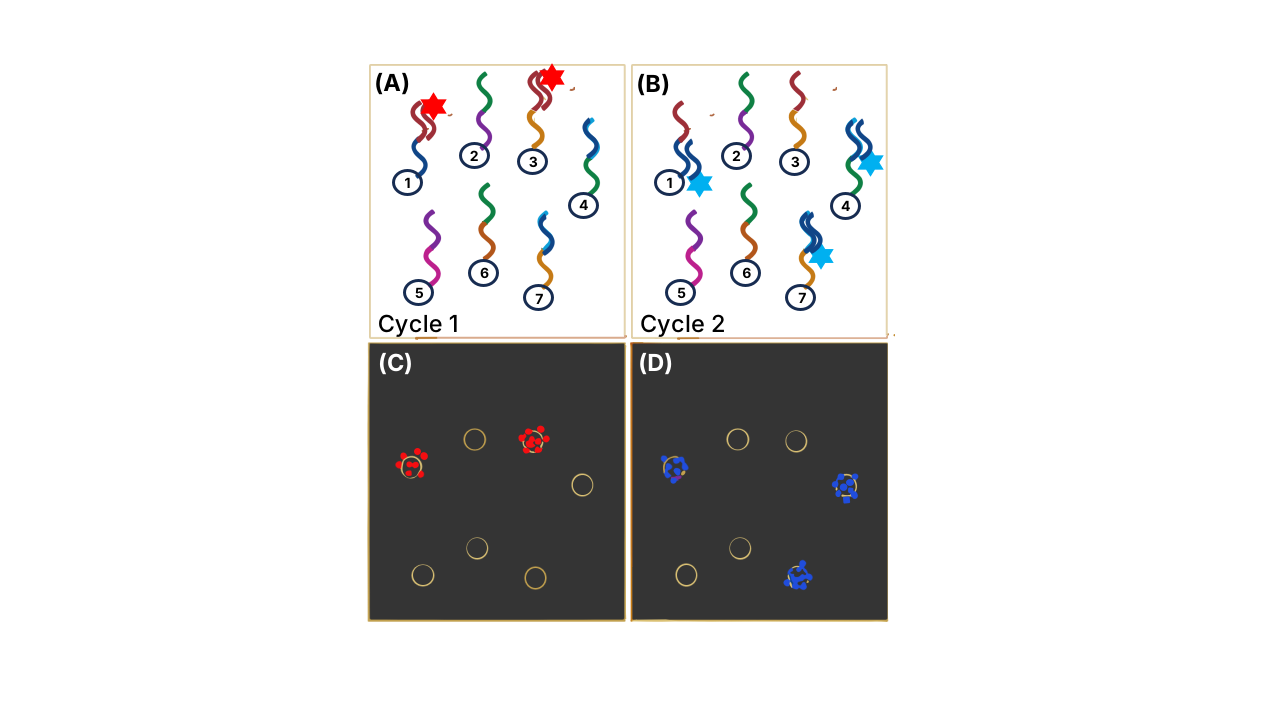
Schematic of combinatorial DNA-PAINT. (A) Each protein target is shown as a number. For simplicity, the antibodies are not illustrated. Protein 1 is labeled with an antibody conjugated to an oligo (blue and red). When the complementary fluorescent red imager strand binds (red star), a signal is generated and the target can be imaged (C). The same red imager strand also binds to the oligo sequence on protein 3. (B) In the second imaging cycle, the fluorescent blue imager strand binds to oligo sequences on proteins 1, 4, and 7. By combining the signal patterns from both cycles, the analysis identifies protein 1 as the target that carries both red and blue barcodes.
DNA-PAINT in Action
The paper benchmarks the approach on both model systems and cells, showing that combinatorial coding can work with high spatial precision rather than only in simplified test designs. The reported 41-target experiment used just 6 imaging rounds over a 100 × 100 μm² field of view, with localization precision around 2.5 nm and decoding accuracy around 90%, while in situ cell experiments reached 97% decoding accuracy.
Those numbers matter because they show that the method is not just multiplexed on paper. It is sufficiently accurate to support real spatial assignment, which is the make-or-break requirement for any combinatorial readout in super-resolution microscopy.
What Broader Adoption Will Require
The commercial implication is straightforward. Combinatorial DNA-PAINT reduces the reagent and time burden of high-plex imaging, but broader adoption will depend on access to AOCs with well-behaved, orthogonal, and well-characterized handle sequences. Researchers will need conjugates that are not only target-specific, but also sequence-compatible, kinetically balanced, and easy to decode in a panel context.
That raises the bar for reagent design and QC. Cross-hybridization, uneven imager binding behavior, or variation in handle accessibility could all compromise decoding performance long before microscope resolution becomes the limiting factor. For 50+ target super-resolution imaging to become routine, the field will need better standardization around handle architecture, orthogonality, and conjugate characterization.
For AbOliGo, that is exactly where the opportunity sits. In next-generation spatial proteomics, the oligo portion of an AOC is not just a barcode. It increasingly defines how efficiently the panel scales. That same modular logic is also reflected in Flexible Multiplexed Imaging via Cyclic Immunofluorescence with DNA-Barcoded Antibodies, where signal readout is likewise separated from the underlying antibody binder.
Key takeaway: In next-generation multiplex assays, the oligo is not just attached to the antibody. It increasingly determines what the assay can become.