Mapping Ion Channel Expression Across Brain Regions with Multiplexed Imaging
Key takeaways
- Multiplexed antibody-oligonucleotide conjugate (AOC) imaging maps voltage-gated sodium, potassium, and HCN channels simultaneously at cellular resolution, where conventional immunofluorescence is limited to three or four markers by fluorophore spectral overlap.
- AOCs link each antibody to a unique DNA barcode detected by complementary fluorescent reporters, enabling iterative hybridization cycles that image 40 to 60 or more markers from a single tissue section without disturbing bound antibodies.
- The AbOliGo ion channel panel covers twelve targets across three families: Nav1.1, Nav1.6, and Nav1.7 sodium channels; Kv1.1, Kv1.3, Kv2.1, Kv3.1B, Kv4.2, Kv4.3, and Slack potassium channels; and HCN1 and HCN4.
- Co-mapping Nav1.1 with Kv3.1B in the same section identifies the complete fast-spiking ion channel signature of parvalbumin-positive interneurons, a combinatorial readout invisible to single-channel immunostaining.
The Molecular Basis of Neuronal Electrical Identity
The electrical behavior of a neuron is determined largely by the complement of ion channels it expresses. Across the mammalian brain, hundreds of neuronal subtypes each deploy a distinct repertoire of voltage-gated sodium, potassium, and hyperpolarization-activated channels, giving rise to the diversity of firing patterns that underpin sensory processing, motor coordination, and cognition. Understanding which channels are expressed where, and in what combinations, is a central challenge in systems neuroscience.
Until recently, mapping ion channel expression at scale required trade-offs between spatial resolution and molecular breadth. In situ hybridization could localize transcripts for a handful of targets at a time. Conventional immunofluorescence could visualize two to four proteins per tissue section. Neither approach captured the combinatorial reality of channel expression across dozens of markers simultaneously.
That landscape has shifted. The Allen Institute's whole-brain cell atlas, which combined single-cell RNA sequencing of approximately seven million cells with spatial transcriptomic mapping via MERFISH, revealed extraordinary molecular diversity and spatial heterogeneity among neuronal populations1. At the protein level, spatial proteomics, named Method of the Year 2024 by Nature Methods2, has matured into a practical tool for profiling 40 to 60 or more targets in a single tissue section. Together, these advances have created the foundation for comprehensive ion channel mapping at cellular resolution.
This article reviews the major voltage-gated ion channel families expressed in the brain, examines the distinct spatial distributions that define neuronal subtypes, and considers how multiplexed imaging with antibody-oligonucleotide conjugates enables panel-based approaches that bring the full ion channel landscape into view.
Ion Channel Distribution Across Brain Regions
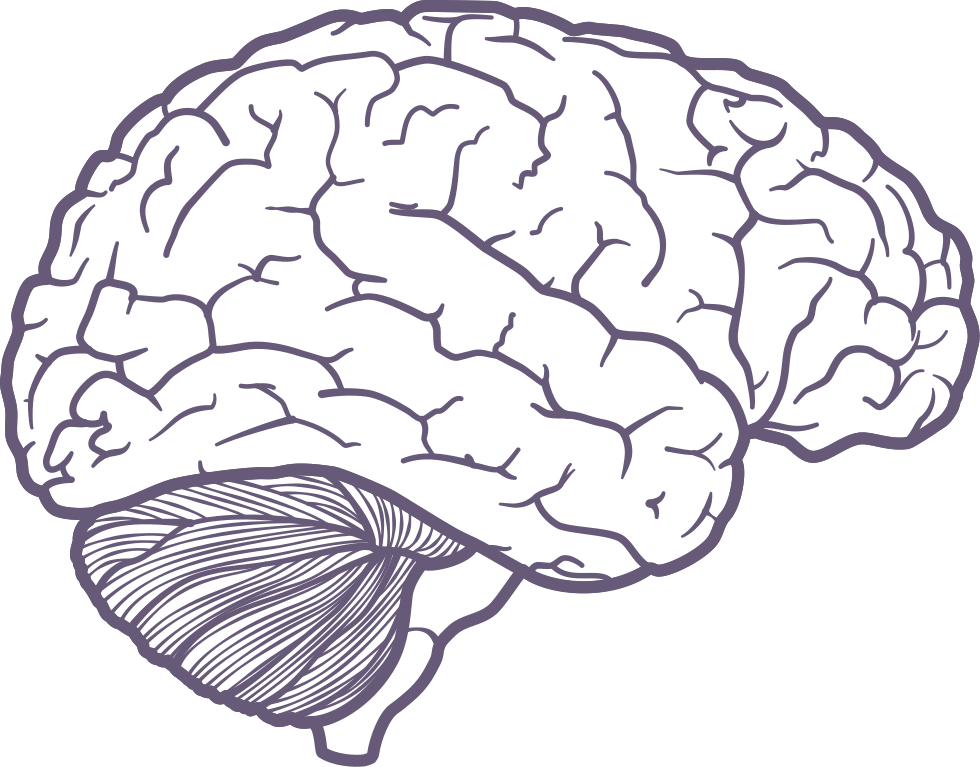
PV+ Interneurons
Nav1.1 · Kv3.1B
Cortical
Kv2.1 · Kv4.3
Cerebellum
Nav1.6 · Kv1.1 · HCN1
Thalamus
HCN4
Hippocampus
Kv4.2 · HCN1
DRG
Nav1.7
Figure 1. Distribution of voltage-gated ion channels across brain regions. Twelve ion channel targets spanning three channel families (Na⁺, K⁺, HCN) mapped to their primary expression sites in the mammalian brain.
Voltage-Gated Sodium Channels: Initiating and Propagating the Action Potential
Voltage-gated sodium channels are responsible for the rapid depolarization phase of the action potential. In the central and peripheral nervous systems, three alpha subunits — Nav1.1 (SCN1A), Nav1.6 (SCN8A), and Nav1.7 (SCN9A) — exhibit strikingly different cell-type and subcellular expression patterns, each with distinct functional and pathological significance.
Nav1.1, encoded by SCN1A, is predominantly expressed in parvalbumin-positive (PV+) GABAergic inhibitory interneurons, where it localizes to the soma and proximal axon. Ogiwara and colleagues demonstrated this localization using triple immunofluorescent staining, showing that Nav1.1 is essential for the sustained high-frequency firing that characterizes PV+ interneurons3. Loss-of-function mutations in SCN1A cause Dravet syndrome, a severe developmental epilepsy, not because of reduced excitation but because of selective impairment of inhibitory interneuron firing. More recent work using Scn1a-GFP transgenic mice has revealed additional Nav1.1 expression in neocortical pyramidal tract projection neurons, suggesting a more nuanced expression landscape than initially appreciated4. Spatial mapping of Nav1.1 alongside inhibitory neuron markers can therefore distinguish between its interneuronal and projection neuron roles.
Nav1.6, encoded by SCN8A, occupies a complementary spatial niche. It is the dominant sodium channel at the axon initial segment (AIS) of mature neurons and at nodes of Ranvier along myelinated axons, where it drives reliable action potential initiation and saltatory conduction. In the cerebellum, Nav1.6 clusters at the AIS of granule cells and is responsible for the persistent sodium current that tunes spike timing5. During development, Nav1.6 gradually replaces Nav1.2 at the AIS, a process that shapes the evolution of neuronal excitability from neonatal to adult stages6. Co-localization of Nav1.6 with markers such as CASPR at nodes of Ranvier provides a direct spatial readout of myelinated axon integrity.
Nav1.7 (SCN9A) represents a fundamentally different expression domain. Preferentially expressed in nociceptive primary sensory neurons of the dorsal root ganglia (DRG) and in sympathetic neurons, Nav1.7 functions as a threshold channel that amplifies small subthreshold depolarizations. Its role is so specific that gain-of-function mutations produce severe neuropathic pain, while loss-of-function mutations result in congenital insensitivity to pain7,8. Including Nav1.7 in a multiplexed panel alongside central sodium channels provides a complete view of excitatory drive across both the peripheral and central nervous systems.
Potassium Channel Diversity: Repolarization and Firing Pattern Control
If sodium channels initiate the action potential, potassium channels terminate it, and they do so with extraordinary functional diversity. The mammalian brain expresses dozens of voltage-gated potassium channel subunits, and the specific combination of Kv channels expressed by a neuron is a primary determinant of its firing pattern, spike width, and repetitive firing capacity9.
The Kv1 subfamily (KCNA) encodes delayed rectifier-type channels that activate at subthreshold voltages and modulate action potential threshold and interspike interval. Kv1.1 (KCNA1) is broadly expressed in the mammalian brain, with particularly high levels in the cerebellar cortex, specifically in the terminals of inhibitory basket cells and in the amygdala, where Kv1.1 channels mediate feed-forward inhibition in local circuits10. Kv1.3 (KCNA3) has drawn attention for its dual role in neurons and immune cells, including microglia, positioning it at the intersection of neural excitability and neuroinflammation. Together, Kv1.1 and Kv1.3 offer complementary windows into Kv1 subfamily function across neuronal and glial compartments.
Kv2.1, encoded by KCNB1, is the principal delayed rectifier in most central neurons and a major contributor to somatodendritic potassium currents that regulate repetitive firing. Beyond its electrical role, Kv2.1 forms large clusters on the neuronal soma and proximal dendrites that serve as membrane-cytoskeleton organizing platforms. Recent work has revealed that integrin-Kv2.1 complexes regulate neocortical neuronal development, with implications for epilepsy11.
The Kv3 subfamily stands out for its specialized role in fast-spiking interneurons. Kv3.1B (KCNC1) is co-expressed with parvalbumin in inhibitory interneurons across the neocortex, hippocampus, thalamus, and striatum12. The rapid activation and deactivation kinetics of Kv3 channels enable the brief action potentials and short refractory periods required for sustained high-frequency firing, the very same fast-spiking phenotype supported by Nav1.113. This functional convergence means that co-mapping Nav1.1 and Kv3.1B in the same tissue section directly identifies the complete fast-spiking ion channel signature of PV+ interneurons. Notably, Kv3.1-containing channels are reduced in untreated schizophrenia and normalized by antipsychotic treatment, underscoring the translational relevance of precise Kv3 channel quantification14.
The Kv4 subfamily mediates the somatodendritic A-type potassium current (ISA), a rapidly inactivating current that regulates dendritic excitability and back-propagating action potentials. Kv4.2 (KCND2) is the predominant A-type channel in hippocampal CA1 pyramidal neuron dendrites, where it controls dendritic signal integration, spike timing, and synaptic plasticity15. In the dentate gyrus, dendritic Kv4.2 channels selectively mediate spatial pattern separation, linking channel expression directly to cognitive function16. Kv4.3 (KCND3) shares many of these dendritic roles and has overlapping but distinct expression patterns across cortical and subcortical structures.
Slack (Slo2.2), encoded by KCNT1, is a sodium-activated potassium channel with a unique physiological role. Unlike voltage-gated Kv channels, Slack is activated by intracellular sodium, coupling neuronal activity to a potassium conductance that limits excessive firing. Gain-of-function mutations in KCNT1 produce severe developmental and epileptic encephalopathies accompanied by intellectual disability17. Disease-causing Slack mutations produce opposite effects on excitability of excitatory versus inhibitory neurons, illustrating how a single channel gene can have cell-type-specific consequences that reshape circuit function18.
HCN Channels: Pacemaker Currents and Dendritic Integration
Hyperpolarization-activated cyclic nucleotide-gated (HCN) channels occupy a unique functional niche: they are activated by membrane hyperpolarization rather than depolarization, generating the Ih current that depolarizes the membrane back toward threshold. In neurons, this current contributes to resting membrane potential, dendritic integration, synaptic filtering, and oscillatory activity.
HCN1 and HCN4 exhibit strikingly complementary distributions in the brain. HCN1 expression is enriched in the cerebral cortex, hippocampus, cerebellum, and the facial motor nucleus, regions associated with rapid signal integration and high-frequency information processing19. In CA1 pyramidal cells, HCN1 channels are concentrated in the distal dendrites, where they attenuate the temporal summation of synaptic inputs and normalize the impact of distal versus proximal synapses, a process critical for dendritic computation.
HCN4, by contrast, is most abundantly expressed in thalamic relay nuclei, where it generates the slow pacemaker currents that drive thalamocortical oscillations. Zobeiri and colleagues demonstrated that HCN4 is essential for oscillatory activity in the thalamocortical system, and its disruption alters the balance between tonic and burst-mode firing that underlies transitions between wakefulness and sleep20. The selective thalamic enrichment of HCN4, combined with its slower activation kinetics compared to HCN1, makes it a definitive marker for thalamic pacemaker circuits.
Mapping HCN1 and HCN4 simultaneously across brain sections reveals how the brain distributes fast versus slow Ih conductances across different circuits, information that is largely invisible to single-channel immunostaining approaches.
From Single Targets to Multiplexed Panels: The Role of Antibody-Oligonucleotide Conjugates
The ion channel families described above illustrate a fundamental challenge: understanding neuronal identity requires simultaneous detection of many channels in the same tissue section. Conventional immunofluorescence is limited to three or four markers by spectral overlap of fluorophores. Serial staining and stripping approaches can extend this range, but risk tissue degradation and epitope damage with each cycle.
Antibody-oligonucleotide conjugates (AOCs) overcome this limitation through a fundamentally different detection strategy. Each antibody is covalently linked to a unique single-stranded DNA barcode. Detection occurs not through a directly conjugated fluorophore, but through hybridization of complementary fluorescently labeled oligonucleotide reporters. This DNA-mediated architecture decouples antibody binding from fluorescent readout and enables iterative cycles of hybridization, imaging, and dehybridization, with each cycle revealing a new set of targets without disturbing the bound antibodies. For an overview of the full range of scientific techniques enabled by antibody-oligonucleotide conjugates, our companion article provides a comprehensive reference.
The CODEX platform (CO-Detection by indEXing) exemplifies this approach. Unlike cyclic immunofluorescence methods that require sequential antibody application, CODEX allows all DNA-conjugated antibodies to be applied to the tissue simultaneously, preserving epitope integrity and dramatically reducing staining time. Panels of 40 to 60 markers can be imaged from a single tissue section, with each marker rendered visible by its complementary fluorescent reporter oligonucleotide in successive imaging cycles21,22. Related platforms — including SABER-IMC for signal amplification of low-abundance targets and IN-DEPTH for integrated spatial proteomics and transcriptomics — extend the toolkit further.
For ion channel mapping, this technology is transformative. A single multiplexed panel can simultaneously localize all twelve voltage-gated ion channels discussed in this article, together with cell-type markers and additional targets, in one tissue section. The result is not a collection of single-channel maps, but a genuine combinatorial profile: which channels co-localize in the same cells, how expression ratios vary across brain regions, and how the channel complement of a neuron relates to its molecular cell type.
Designing an Ion Channel Panel for Spatial Neuroscience
Constructing a multiplexed ion channel panel requires consideration of biological questions, technical constraints, and analytical goals. Several principles guide effective panel design.
First, include both target channels and cell-type markers. Ion channel signals gain biological meaning when anchored to identified cell populations. Pairing sodium and potassium channel AOCs with markers for major cell types — such as GFAP and Aldh1L1 for astrocytes, calbindin for specific neuron subtypes, or VGlut1 for excitatory neurons — enables channel expression to be assigned to specific cell classes during computational analysis.
Second, balance breadth and redundancy. A twelve-channel ion channel panel that covers sodium, potassium, and HCN families captures the major axes of electrical identity. Adding functionally related targets such as glutamate receptors (GluA1, GluN1) or inhibitory markers (GABA-B-R1) contextualises channel expression within the broader synaptic landscape.
Third, optimize conjugation parameters. The degree of oligonucleotide labeling per antibody, the choice of conjugation chemistry, and the blocking strategy all influence signal-to-noise ratio in multiplexed panels. For guidance on fine-tuning AOC parameters and eliminating non-specific binding, our technical resources provide detailed protocols and recommendations. For low-abundance ion channel targets, signal amplification strategies such as SABER can boost sensitivity without requiring enzymatic amplification.
Finally, validate panel performance on well-characterized tissue. The hippocampus, with its well-defined laminar structure and extensively characterized channel expression gradients — HCN1 enrichment in CA1 stratum lacunosum-moleculare, Kv4.2 in CA1 dendrites, Nav1.1 in interneurons of stratum pyramidale — serves as an excellent validation tissue for new ion channel panels. Our immunofluorescence protocol for antibody-oligo conjugates provides a starting point for tissue preparation and staining workflows.
Ion Channel AOC Panel — Product Summary
All twelve voltage-gated ion channel AOCs available for multiplexed spatial neuroscience panels.
Na+ Channels
- Nav1.1 (SCN1A) — PV+ interneurons
- Nav1.6 (SCN8A) — AIS, nodes of Ranvier
- Nav1.7 (SCN9A) — Nociceptors, DRG
K+ Channels
- Kv1.1 (KCNA1) — Basket cells, cerebellum
- Kv1.3 (KCNA3) — Neurons, microglia
- Kv2.1 (KCNB1) — Somatodendritic clusters
- Kv3.1B (KCNC1) — Fast-spiking interneurons
- Kv4.2 (KCND2) — CA1 dendrites
- Kv4.3 (KCND3) — Cortical, subcortical dendrites
- Slack (KCNT1) — Na+-activated, widespread
Looking Forward
The intersection of spatial proteomics technology and ion channel neuroscience opens experimental doors that were closed just five years ago. Multiplexed imaging with antibody-oligonucleotide conjugates enables researchers to move beyond single-target studies and construct comprehensive channel profiles at cellular resolution. As panel sizes continue to grow and computational analysis pipelines mature, the combinatorial ion channel code that defines neuronal electrical identity is becoming directly observable, one tissue section at a time.
Explore our full range of neuroscience AOCs in the product catalog, or contact us about custom conjugation services for targets not yet in our catalog.
References
- Zhang et al. A high-resolution transcriptomic and spatial atlas of cell types in the whole mouse brain. Nature (2023).
- Method of the Year 2024: spatial proteomics. Nature Methods (2025).
- Ogiwara et al. Nav1.1 localizes to axons of parvalbumin-positive inhibitory interneurons: a circuit basis for epileptic seizures in mice carrying an Scn1a gene mutation. J Neurosci (2007).
- Scn1a-GFP transgenic mouse revealed Nav1.1 expression in neocortical pyramidal tract projection neurons. (2023).
- Persistent Nav1.6 current at axon initial segments tunes spike timing of cerebellar granule cells. J Physiol (2010).
- Differential roles of NaV1.2 and NaV1.6 in regulating neuronal excitability at febrile temperature and distinct contributions to febrile seizures. Sci Rep (2017).
- NaV1.7: A central role in pain. Neuron (2023).
- Dib-Hajj et al. Genetics and molecular pathophysiology of Nav1.7-related pain syndromes. J Pain (2009).
- Bhatt & Bhatt. Voltage-gated potassium channels and the diversity of electrical signaling. J Physiol (2012).
- Kv1.1 channels mediate network excitability and feed-forward inhibition in local amygdala circuits. Sci Rep (2021).
- Integrin-KCNB1 potassium channel complexes regulate neocortical neuronal development and are implicated in epilepsy. Cell Rep (2022).
- Fast-spiking parvalbumin-positive interneurons in brain physiology and Alzheimer's disease. Mol Psychiatry (2023).
- Function of specific K+ channels in sustained high-frequency firing of fast-spiking neocortical interneurons. J Neurophysiol (1999).
- Kv3.1-containing K+ channels are reduced in untreated schizophrenia and normalized with antipsychotic drugs. Mol Psychiatry (2013).
- Kv4 potassium channel subunits control action potential repolarization and frequency-dependent broadening in rat hippocampal CA1 pyramidal neurons. J Physiol (2005).
- Dendritic Kv4.2 potassium channels selectively mediate spatial pattern separation in the dentate gyrus. (2021).
- Barcia et al. Missense mutations in the sodium-gated potassium channel gene KCNT1 cause severe autosomal dominant nocturnal frontal lobe epilepsy. Nat Genet (2012).
- Disease-causing Slack potassium channel mutations produce opposite effects on excitability of excitatory and inhibitory neurons. (2024).
- Differential distribution of four hyperpolarization-activated cation channels in mouse brain. (1999).
- Zobeiri et al. The hyperpolarization-activated HCN4 channel is important for proper maintenance of oscillatory activity in the thalamocortical system. Cereb Cortex (2019).
- CODEX multiplexed tissue imaging with DNA-conjugated antibodies. Nat Protoc (2021).
- Spatial mapping of protein composition and tissue organization: a primer for multiplexed antibody-based imaging. Nat Methods (2021).